


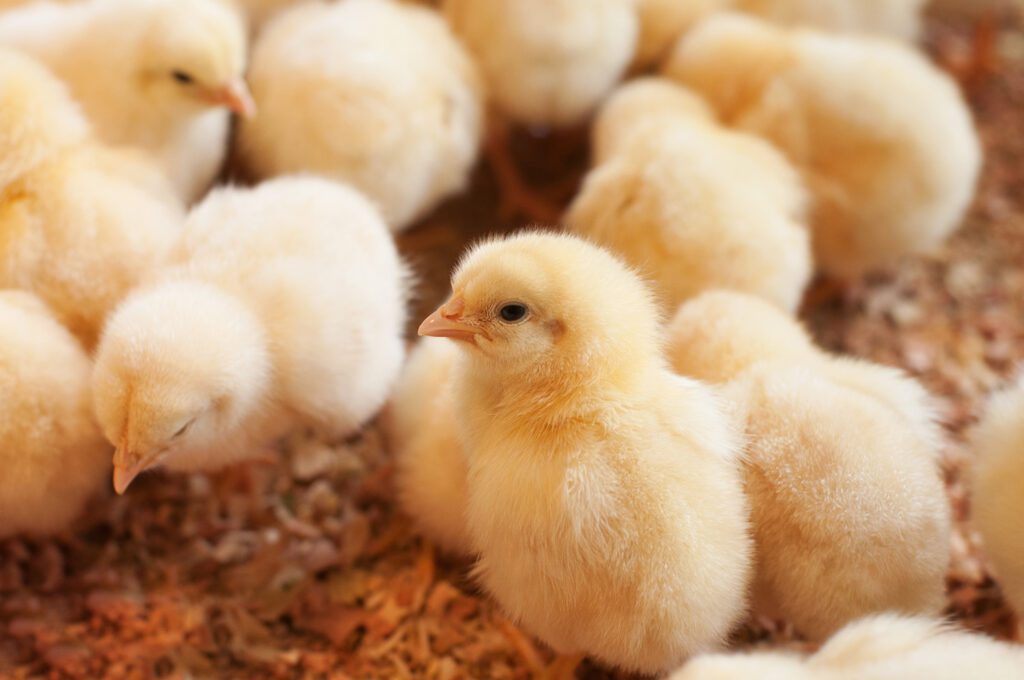
What happens in the first few weeks of raising broiler chicks determines nearly everything about how your birds perform at processing time. Get the setup right, feed consistently, and understand what healthy growth looks like, and you give yourself the best possible outcome.
Whether you are managing a backyard flock or producing for a farm-to-table market, this guide walks you through exactly what to do from the moment your chicks arrive.
Do not wait until the day your chicks show up to get your brooder ready. Temperature swings and disorganized setups in those first hours cost you growth and, in some cases, birds.
Space. Plan for at least half a square foot per chick during the first two weeks. Broiler chicks grow fast, and crowding them early creates stress that slows feed intake and increases the risk of respiratory issues. By week three, you need to be at one square foot per bird.
Bedding. Use clean pine shavings or rice hulls. Avoid newspaper and other slick surfaces, which can cause leg problems in young chicks. Replace wet spots around waterers immediately. Wet bedding is one of the most consistent contributors to poor flock health. Never use cedar shavings. While they may smell good, the oils from cedar are not good for your chicks.
Heat Source. Start at 95 degrees Fahrenheit directly under the heat lamp during the first week. Drop the temperature by five degrees each week as chicks feather out. Your birds will tell you when the temperature is off. Chicks piling under the lamp are cold. Chicks scattered far from the lamp are too warm. Chicks spread evenly across the brooder and moving freely are right where they need to be.
The first three days are the most critical stretch of your broiler chicks’ lives. Your job is simple: keep feed and clean water in front of them at all times.
Position your feeders and waterers at beak height so chicks are not straining to reach them and are not kicking bedding into the trays. Check them at least twice a day. A single stretch without water access can set your birds back several days in growth, and dirty water introduces health problems that are far harder to recover from than they are to prevent.
A general starting point is one linear inch of feeder space and one quart of waterer capacity per chick for the first week. Scale both up as your birds grow.
Nutrition is where broiler performance is made or lost. Start on a chick starter feed formulated specifically for meat birds, with a crude protein content of 20 to 24 percent. That high protein level supports the rapid muscle development that defines broiler performance. Do not use a layer starter. Layer formulas are designed for a different production goal and carry calcium levels that are not appropriate for young broilers.
At three to four weeks, transition to a broiler grower feed in the 18 to 20 percent protein range. In weeks five to six, move to a finisher ration that slightly reduces protein while supporting final weight gain before processing.
Transition between rations gradually by mixing the new feed in over several days when possible. Abrupt switches could stress the digestive system and slow or stall growth.
Water drives feed intake. A chick that is not drinking consistently is not eating consistently, and that gap shows up at the scale.
Knowing your breed’s growth curve helps you catch problems early and plan your processing timeline with confidence. Freedom Ranger Hatchery offers two proven meat birds that cover a range of production goals: the fast-finishing White Ranger and the moderately paced Freedom Ranger.
The White Ranger is closely related to the Cornish Cross and delivers similar fast-finishing performance with added hardiness. It is a reliable choice for growers who want a quick turnaround without sacrificing bird quality.
The Freedom Ranger is built for a moderate growth pace, making it well-suited for free-range and pasture programs, farm-to-table operations, and anyone who wants a more active, forage-ready bird.
If you are tracking performance, weigh a sample of birds weekly. If weights are running behind, check feed access, water quality, stocking density, and brooder temperature before assuming a health issue. Both breeds perform best under consistent management, and the growth charts linked above give you specific weekly benchmarks to track against.
A few consistent errors show up across operations of every size when raising broilers:
Raising broiler chicks well comes down to preparation and consistency. Give your birds a clean brooder, the right heat, quality feed from day one, and reliable water access, and they will perform. Your role is to keep conditions right and pay attention to what your flock is showing you.
At Freedom Ranger Hatchery, we hatch healthy broiler chicks and ship them within 24 hours of hatching so they arrive strong and ready to start growing. If you are ready to start your flock or want guidance on which breed fits your goals best, browse our available breeds online or call us today.